Skip to main content
Targeted Lat Destruction: The single-arm dumbbell row is an exceptional unilateral exercise that allows you to focus entirely on one side of your back at a time, maximizing the mind-muscle connection with your lats. Fixes Muscle Imbalances: By training each arm independently, it ensures your dominant side doesn't do all the work, helping you correct strength and size asymmetries between your left and right side. Extended Range of Motion: Because a dumbbell isn't blocked by your torso like a barbell, you can let the weight drop lower for a deep stretch at the bottom and pull further back for an intense contraction at the top. Lower Back Friendly: Using a bench to support your non-working hand and knee takes the stress off your lower back, making it a safer rowing alternative if you experience lumbar fatigue or tightness. Core Stability Bonus: Pulling a heavy weight on just one side forces your core and rotators to engage intensely to prevent your torso from twisting, building functional, anti-rotational core strength.
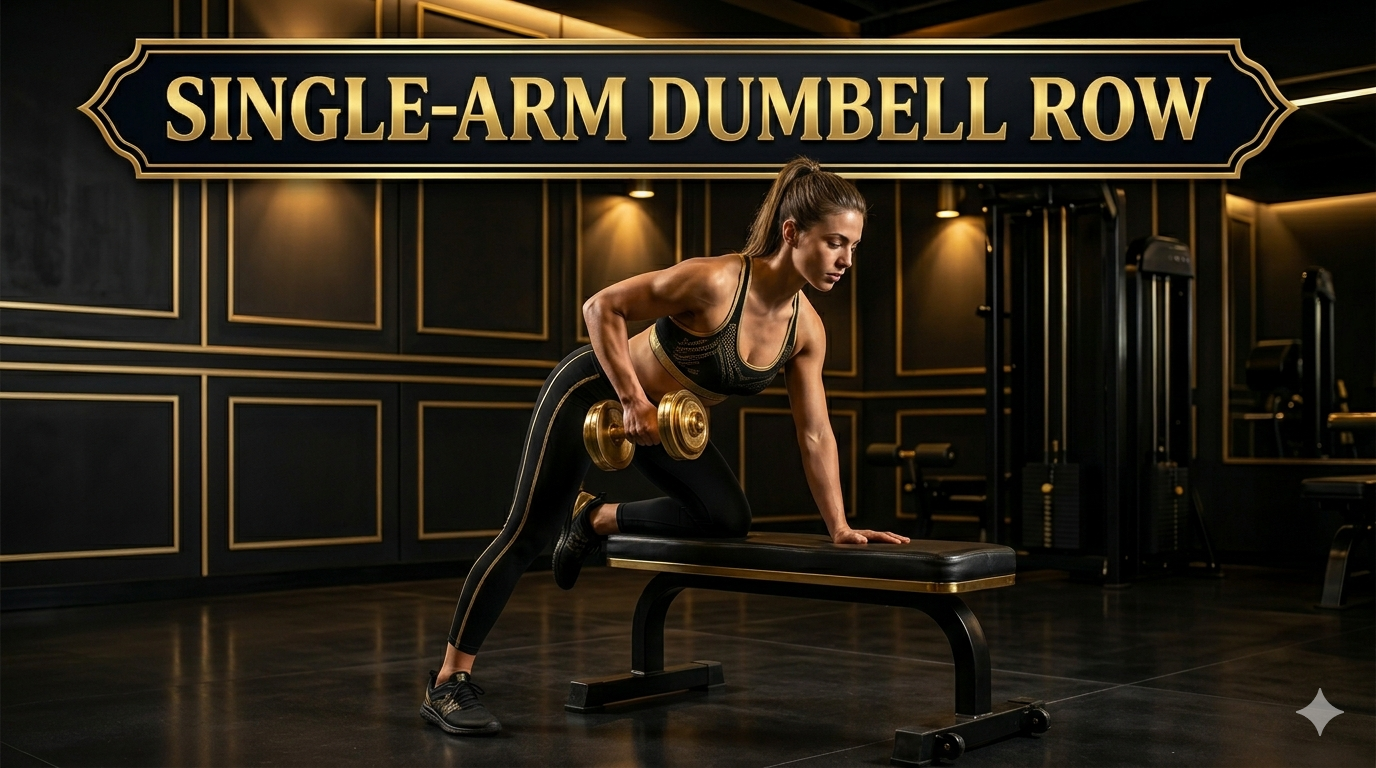
The Single Arm Dumbbell Row is a strength-training exercise performed with one dumbbell. One hand and the same-side knee are typically supported on a bench while the opposite arm pulls the dumbbell toward the hip. This movement develops back strength, improves stability, and enhances overall upper-body performance.
Latissimus Dorsi (Lats)
Rhomboids Trapezius
Rear Deltoids
Biceps
Forearms
Core Muscles
Erector Spinae
Place your left knee and left hand on a flat bench for support.
Keep your right foot firmly on the floor.
Hold a dumbbell in your right hand with your arm fully extended.
Keep your back straight and your core engaged.
Pull the dumbbell toward your hip while keeping your elbow close to your body. Squeeze your shoulder blade at the top of the movement.
Slowly lower the dumbbell back to the starting position.
Complete all repetitions, then switch to the other arm.
Builds a stronger and wider back. Improves muscle balance between the left and right sides. Increases upper-body pulling strength. Enhances grip and forearm strength. Improves posture by strengthening the upper back. Engages the core for better stability. Supports better performance in pull-ups, deadlifts, and other rowing exercises.
Rounding your back during the movement.
Using momentum instead of controlled motion.
Pulling the dumbbell toward the shoulder instead of the hip.
Twisting the torso excessively.
Lifting a weight that is too heavy.
Rushing the lowering phase of the exercise.